

Doctor OhVely's Beauty Column
What Is Botox? Why a Customized Approach Matters for Each Area, from Expression Lines to Facial Contouring | Hongdae Botox
Hongdae Botox Key Summary
Botox is a treatment that uses botulinum toxin to temporarily control the movement of specific muscles. It is used to reduce wrinkles in areas that move repeatedly during facial expressions, such as the forehead, glabella, and around the eyes, and can also be applied to areas such as the square jaw, where the degree of muscle development affects facial contours.
However, even though it is the same Botox treatment, it is not performed in the same way for every area.
It is important to examine the location and strength of the muscles that create facial expressions, the balance between the left and right sides of the face, and habitual facial expressions, and then appropriately approach the necessary areas.
What Is Botox?
Botox is a treatment used to temporarily control the movement of specific muscles to improve expression wrinkles or changes in facial contours caused by excessively developed muscles.
When expressions such as smiling, frowning, or opening the eyes widely are repeated, certain muscles continue to contract.
Common areas include the forehead, glabella, and around the eyes.
At first, wrinkles may appear only when making facial expressions, but when the same movements are repeated over a long period of time, lines may remain visible even when the face is at rest.
Botox is used to appropriately control the movement of these facial expression muscles and reduce the formation of deep folds.
However, Botox takes a different approach from fillers that add volume to the skin.
It can be more easily distinguished by understanding that Botox controls muscle movement rather than adding volume to hollow areas.
Key Features of Hongdae Botox
✔ A treatment that can be performed in a relatively short amount of time
✔ Management of wrinkles caused by facial muscle movement
✔ Treatment available for specific areas such as the forehead, glabella, and around the eyes
✔ Facial contour management that considers developed muscles, such as the square jaw
✔ Selective treatment of necessary areas rather than the entire face
CHECK POINT
Botox is not simply performed where wrinkles are present. It is important to identify which muscle movements are causing the wrinkles or changes in facial contours.
Why Should Hongdae Botox Be Performed Differently for Each Area?
Because each facial muscle has a different role and direction of movement, the approach to Botox should also vary depending on the treatment area.
Several muscles that create facial expressions are interconnected in the face.
For example, the forehead muscle raises the eyebrows, while the muscles around the glabella are involved in pulling the eyebrows inward.
Therefore, rather than simply focusing on where wrinkles are visible, it is necessary to examine which muscles move strongly during habitual facial expressions.
Even with the same forehead Botox treatment, the treatment plan may vary depending on eyebrow position, habits when opening the eyes, and how much the forehead muscles are used.
The range and direction of wrinkles around the eyes when smiling also differ from person to person.
For square jaw Botox, rather than choosing the treatment simply because the face looks wide, it is important to first determine whether the masticatory muscles are actually developed.
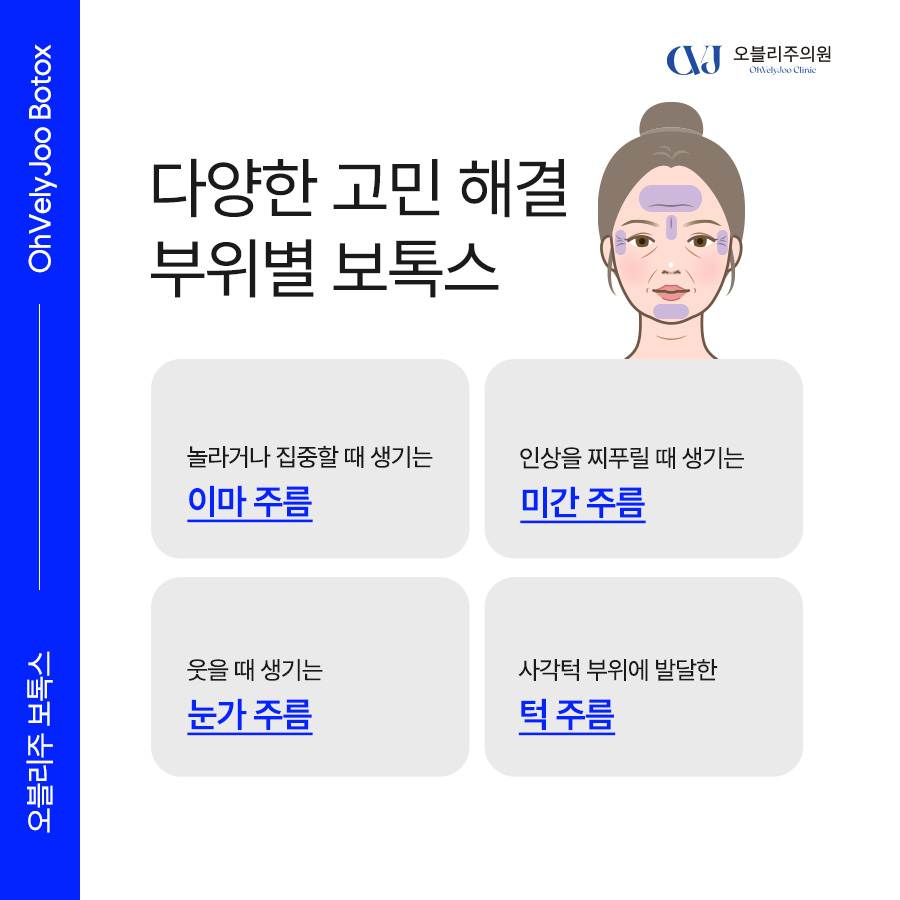
Points to Check for Each Area
Forehead
We check the position of the eyebrows together with habits involving the use of the forehead muscles.
Glabella
We examine the direction in which the muscles between the eyebrows move when frowning.
Eye Area
We check the location and range of wrinkles that appear when smiling.
Square Jaw
We examine the degree of jaw muscle development together with the balance between the left and right sides of the face.
Injecting the same amount into the same locations does not produce the same results for everyone.
This is why facial muscle movement should be checked first.
What Are the Differences Between Forehead, Glabella, and Eye Area Botox?
Although all three areas are treated to manage expression wrinkles, each requires a different approach because the muscles involved and the desired changes are different.
The areas most frequently discussed by people considering Botox for the first time are the forehead, glabella, and eye area.
However, the causes of wrinkles in these three areas are slightly different.
Horizontal forehead wrinkles often appear due to repeated movements that raise the eyebrows.
Vertical glabellar wrinkles are associated with habits such as frowning or pulling the eyebrows inward.
Wrinkles around the eyes may appear as the muscles surrounding the eyes move repeatedly when smiling or squinting.
Therefore, rather than simply thinking, “I have a lot of wrinkles, so I need a lot of Botox,” it is important to consider the muscle movements in each area so that natural facial expressions can be maintained.
When to Consider Botox for Expression Wrinkles
✔ When wrinkles around the eyes appear prominently when smiling
✔ When deep lines form between the eyebrows when frowning
✔ When prominent forehead wrinkles form when raising the eyebrows
✔ When you habitually repeat certain facial expressions
✔ When you want to reduce deep wrinkle folding while maintaining facial expressions
CHECK POINT
The goal of Botox for expression wrinkles is not to prevent the face from moving,
but to appropriately control excessively active muscles.
How Is Hongdae Square Jaw Botox Different From Wrinkle Botox?
Square jaw Botox is used to manage facial contours by assessing the degree of development of the masticatory muscles around the jaw rather than focusing on skin wrinkles.
The muscles that protrude firmly on both sides of the jaw when you clench your teeth are called the masseter muscles.
If you habitually clench your teeth or use your jaw muscles heavily when chewing food,
these muscles may become developed, making the lower face appear wider.
In this case, Botox may be considered to control muscle movement with the goal of making the facial contours appear softer over time.
However, muscle development is not the only reason a face may appear wide.
Several factors, including facial bone structure, the amount of fat, and skin sagging, can affect facial contours,
so the cause should be identified first.
If muscle development is not the main cause, the changes expected from square jaw Botox alone may be limited.
When Square Jaw Botox May Be Considered
✔ When the jaw muscles protrude significantly when clenching the teeth
✔ When developed jaw muscles make the lower face appear wider
✔ When the degree of jaw muscle development differs between the left and right sides
✔ When you habitually put a lot of tension on your jaw
✔ When muscle development is a major reason the facial contours appear strong
CHECK POINT
For square jaw Botox, rather than asking ‘Is the face wide?’
it is important to first determine ‘Is muscle development the reason the face appears wide?’
Is More Botox More Effective?
Rather than using a large amount of Botox,
it is important to plan the appropriate treatment range and dosage according to the target area and muscle movement.
During Botox consultations, some people ask, “Will it last longer if I get more?” or
“Will the effect be better if it is stronger?”
However, Botox is not a treatment in which the results are determined simply by the amount used.
In particular, the face contains muscles that move in opposite directions.
If the movement of a specific muscle is reduced excessively, the balance with other muscles may change,
making facial expressions feel different from usual.
Therefore, it is important to examine the treatment area and muscle strength while considering both natural facial expressions and the desired changes.
If the muscle strength differs between the left and right sides of the face, the dosage and injection locations may also need to be adjusted carefully.
You May Consider a Consultation for These Concerns
✔ When prominent forehead wrinkles appear during facial expressions
✔ When you habitually frown between the eyebrows
✔ When wrinkles around the eyes are a concern when smiling
✔ When developed jaw muscles make the facial contours appear wider
✔ When you notice differences in muscle movement between the left and right sides of the face
✔ When you want a natural change in appearance rather than an artificial-looking change
What Is Most Important During a Hongdae Botox Consultation?
During a Botox consultation, rather than deciding on the product or dosage first,
it is important to check which muscles are moving and how they move in the current face.
Looking only at the face at rest is different from actually making facial expressions.
By raising the forehead, frowning, smiling, and clenching the teeth,
differences in the direction and strength of muscle movement can be identified for each person.
Even with the same glabellar wrinkles, one side may have stronger muscle movement,
and even when the face appears to have the same square jaw, facial structure or other factors may actually have a greater influence than the muscles.
Therefore, before deciding which product to use, it is important to first identify the cause of the current concern.
Also, if you have received Botox before, it can be helpful during the consultation to check which areas were treated
and how your facial expressions or sensations felt after the treatment.
CHECK POINT
Botox may seem like a relatively simple treatment performed on small areas,
but because it involves muscles directly connected to facial expressions, it is important to create a plan that considers individual muscle movement and facial balance.
When considering Botox, many people first look at the price, product, or dosage.
However, in actual treatment, where and how it is applied is just as important as what is used.
This is because areas that create facial expressions, such as the forehead, glabella, and around the eyes, have different treatment goals from areas such as the square jaw that affect facial contours.
If you are considering Hongdae Botox, rather than simply checking where wrinkles are located,
it is recommended to examine how the muscles move when making facial expressions and the balance between the left and right sides of the face.
Ohvelyjoo Clinic does not apply the same treatment method to everyone,
but creates a treatment plan that considers a natural appearance by assessing each individual's facial expressions, facial muscle movements, and the degree of desired change.
Maintaining your natural expressions while adjusting only the areas that need it, rather than creating excessive changes.
This is an important point to consider when looking into Hongdae Botox.
Frequently Asked Questions About Hongdae Botox (FAQ)
Q. Is Botox the Same Treatment as Filler?
No. While fillers are mainly used to fill hollow areas or areas that need volume,
Botox is used to temporarily control the movement of specific muscles.
Therefore, the two treatments have different purposes and mechanisms of action.
Q. Will Forehead Botox Make Me Lose My Facial Expressions?
The sensation may vary depending on the treatment area, dosage, and individual muscle movement.
Because the forehead is also related to eyebrow movement,
it is important to create a treatment plan that considers natural facial expressions.
Q. Can I Receive Glabella and Forehead Botox Together?
Depending on the condition of the individual's facial expression muscles, multiple areas may be considered together.
However, because each muscle can affect the others,
it is recommended to first check the overall movement rather than simply treating multiple areas at the same time.
Q. Will Square Jaw Botox Make My Face Look Smaller Immediately?
Square jaw Botox works differently from fillers, which immediately change volume.
Because changes in the muscle gradually appear after controlling the movement of the jaw muscles,
the timing and degree of change may vary depending on the individual's degree of muscle development.
Q. If My Face Is Wide, Should I Get Square Jaw Botox?
A face can appear wide for various reasons, including muscles, bone structure, fat, and skin condition.
It is recommended to first determine whether jaw muscle development is the main cause before deciding on the appropriate method.
Q. Are the Effects of Botox Permanent?
The effects of botulinum toxin are not permanent.
Muscle movement may gradually recover over time,
and the duration and timing may vary depending on the product, treatment area, individual muscle characteristics, and other factors.
Q. Can I Continue Receiving Botox Regularly?
Whether repeated treatments are appropriate and the interval between treatments should be determined based on the product used, treatment area, and individual condition.
It is recommended to consult with medical professionals after checking the timing of the previous treatment and current muscle movement.
Q. Can I Return to Daily Activities Immediately After Botox?
Most people return to daily activities relatively quickly,
but temporary redness, swelling, or bruising may occur at the injection sites.
Post-treatment care may vary depending on the product used and treatment area,
so it is recommended to follow the guidance of medical professionals.
Q. What Is Most Important When Choosing Hongdae Botox?
Rather than comparing only the price or dosage, it is important to thoroughly assess the desired changes and current muscle condition
and determine whether an appropriate treatment plan is created for each area.
Especially if you want natural facial expressions, it can be helpful to check facial muscle movement and the balance between the left and right sides of the face before treatment.